Dispersion manufacture combines solid particles - commonly pigments - into a liquid carrier to achieve a fine, stable, evenly distributed product, typically used in paints, inks, coatings and similar formulations. This page explains the two-stage process and what buyers should consider.
Key points
- Dispersion manufacture is typically a two-step process: wetting followed by milling.
- Milling accounts for most of the process cost and time, since particle size reduction is a gradual, energy-intensive step.
- Several milling equipment types exist - ball mills, bead mills, colloid mills - suited to different fineness requirements.
- Final particle size and fineness of grind are the key quality measures for a dispersion.
How the Process Works
Dispersion manufacture typically proceeds in two stages: first, the solid material - often a pigment - is wetted out to produce a rough dispersion within its intended liquid carrier, using a batching tank and initial mixing. Second, this rough pre-mix passes through one or more milling steps, where grinding media collide and roll against each other, catching and gradually reducing the size of the solid particles.
Suitable Materials and Products
Dispersion manufacture is particularly associated with pigment dispersions for paints, coatings and inks, though the same underlying principles apply to any process requiring solid particles evenly distributed and reduced in size within a liquid carrier - see coatings and paints.
Equipment and Technical Considerations
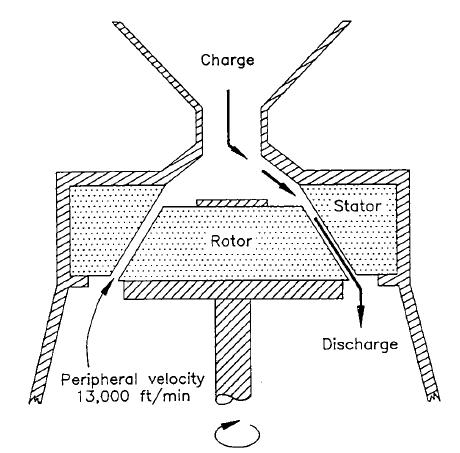
Milling equipment options include ball mills, bead mills, colloid mills and high-speed dispersers, each suited to different fineness requirements and production volumes. Grinding media - which may be glass, ceramic, metal or polymeric beads - is selected based on the hardness and abrasiveness of the material being dispersed.
Batch Sizes and Production Scale
Dispersion manufacture batch sizes are set by tank and mill capacity, and because milling accounts for most of the operating time and cost in this process, batch size has a particularly significant effect on overall production cost - see understanding minimum batch sizes.
Quality and Regulatory Considerations
Fineness of grind - a measure of how thoroughly particles have been reduced and dispersed - is the primary quality test for a dispersion, typically measured using a fineness-of-grind gauge or particle size analysis. Colour consistency and viscosity are also commonly specified quality parameters, particularly for pigment dispersions.
Three Stages, Not One
Making a dispersion is often described as mixing powder into liquid, which understates it. Three distinct things have to happen: the liquid must displace air from the particle surfaces (wetting), agglomerates must be broken into individual particles (dispersion proper), and those particles must be kept apart so they do not re-aggregate (stabilisation).
Each stage needs different treatment, and skipping the first is a common cause of a product that looks acceptable initially and settles or thickens later. Wetting agents and the order of addition matter here as much as the milling energy applied - see dispersion.
Particle Size and Consistency
Most of the properties users care about follow from particle size distribution: colour strength and gloss in pigmented systems, opacity, texture and stability. The same raw materials dispersed well and dispersed poorly give visibly different products, which is why the process is specified rather than left to judgement.
It is also why dispersions can be difficult to transfer between manufacturers - different milling equipment produces different results from identical formulations. Agree how particle size will be measured and what tolerance applies, and expect a trial batch to be needed when production moves.
Questions to Ask a Manufacturer
- What milling equipment do you use, and is it suited to our target fineness?
- How do you measure fineness of grind, and what is your typical achievable result?
- What grinding media do you use, and is it compatible with our formulation?
- How does batch size affect your milling time and cost for this product?
Related Manufacturing Capabilities
Frequently Asked Questions
Why does milling take so long compared to other steps?
Particle size reduction is a gradual, energy-intensive mechanical process, and achieving fine, consistent particle size typically requires multiple passes through the mill, which is why it accounts for most of the operating time and cost.
Does grinding media contaminate the final product?
Well-managed processes minimise this risk through appropriate media selection and process control, but it's worth asking a manufacturer directly how they manage media wear and any contamination risk for your specific product.
Can dispersion manufacture achieve any particle size we specify?
Within limits set by the milling equipment and the material's properties - discuss your target fineness with the manufacturer early, since very fine requirements may need specific equipment or longer processing time.
Find a Manufacturer
Find a UK Contract Chemical Manufacturer
Search the directory of UK contract and toll manufacturers by process, industry and capability.
Search the DirectoryLast reviewed: August 2026. Regulation and guidance change — verify anything you rely on against the primary source. Tell us if something here is out of date.